Table Of Content

This is done, in a technical sense, because the area is subject to flooding thanks to the nearby river. The whole debacle would soon go public, and Farnworth escalated matters by countersuing. The court battle would ultimately rule in his favor, and she was forced to pay him out. Regardless of this immensely messy history, Farnsworth did continue to use the house as a retreat location for just over two decades. The building itself would be completed relatively quickly in only about a year, but prior to the completion of the building, despite the commission being perfect and freeform, there was a dispute. Farnsworth was not particularly happy that the budget of the building had ballooned during the construction of the structure, and as a result, Mies van der Rohe sued his employer for non-payment.
Blue Mosque in Istanbul – Turkey’s Elegant Architecture
Lego Architecture Farnsworth House Online atlantaprogressivenews.com - Atlanta Progressive News
Lego Architecture Farnsworth House Online atlantaprogressivenews.com.
Posted: Sat, 27 Apr 2024 07:31:58 GMT [source]
The transparency allows that from the interior, one is fully conscious of the landscape, but also acts inversely to incorporate the interior of the house into the enclave in an innovative way. Mies acted fully aware of his responsibility and carefully studied each element in function of its impact on the new place he had dictated for it. The architect consciously chose the site conditions where it stands and the means of dealing with them.
History
This is why the International Style became especially prominent in large office skyscrapers. This was done so that it would both better reflect light within the structure, but also to produce a certain exterior design image. The general structure of the house makes use of a steel framework design that allows for the removal of all load-bearing walls. This allows the interior to have an open design, but we will discuss what is done with that open design in time. The façade of the Farnsworth House is made of glass, and this allows the natural landscape around the building to be viewed at all times.
Behind the tour: Farnsworth House
Discover Mies van der Rohe’s modernist masterpiece with our Farnsworth House and Farnsworth House PLUS tours. The design of the house was so acclaimed that a 1947 exhibition of Mies’ work at the Museum of Modern Art included a model of the Farnsworth House before it was even built. Since then, the house has been included in the National Register of Historic Places (2004) and designated a National Historic Landmark (2006).
Types of Art – Learning About the Different Forms of Art
The kitchen includes a stainless-steel continuous counter on one side of the core and a fireplace and primavera wood living space on the other side. At the same time, the prismatic composition of the house maintains a sense of boundary and centrality against the vegetative landscape, thus maintaining its temple-like aloofness. The great panes of glass redefine the character of the boundary between shelter and that which is outside.
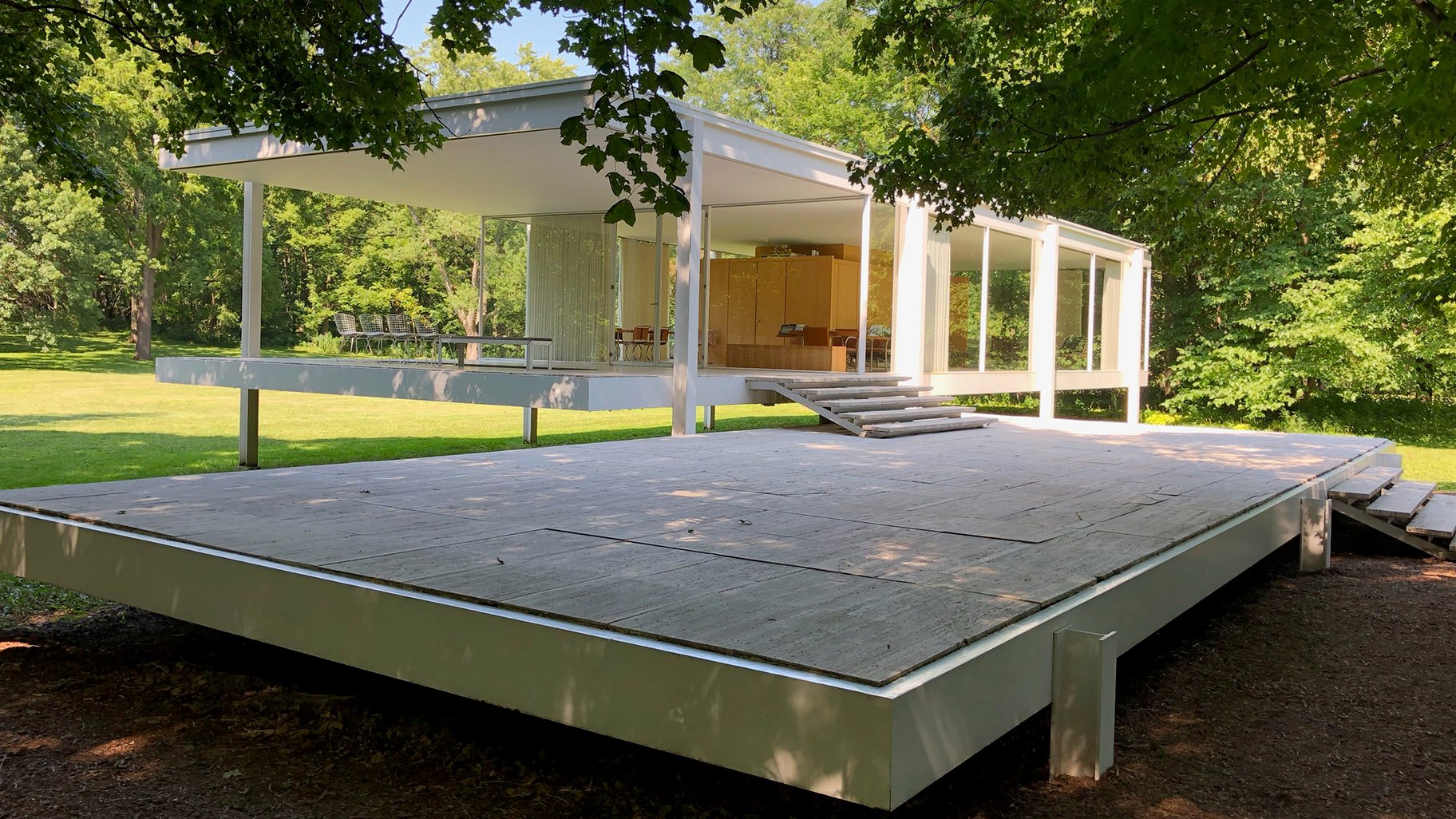
The Farnsworth House did not refer to a historical period and did not attempt to create an enclosure. Wrapping the house in glass reduces the feeling of enclosure and dissolves the boundary between inside and outside. It has a flat roof keeping the silhouette of the building to a simple rectangle absent of any angels or ornamentation. The Farnsworth house is important because it challenged the idea of a conventional home. Simply put, it was so starkly different from homes that people were familiar with at that time.
Related Tour
The large windows that encompass the entire house consist of ¼-inch thick glass panes that are over nine feet high. The widest windowpanes span a whopping 11 feet between the vertical I-beams and are located on the north and east facades. Archilogic’s model helps reveal the spatiality of the Farnsworth house in a way that photography cannot. Mies often favored a kind of pinwheel floorplan, in which the plan might look flexible, but came with strong serving suggestions, not only about what furniture to use, and what to wear, but also what direction to walk in. As a walk around the Archilogic model clearly shows, although all the zones of the house are interconnected, crucial lines of sight are blocked by the wooden core. As transparent as the house may be, the bedroom is not visible from the front door, nor can the living room be seen from the kitchen.
The Herbert F. Johnson Museum of Art: A Window on the Landscape
First conceived in 1945 as a country retreat for the client, Dr. Edith Farnsworth, the house, as finally built, appears as a Platonic structure in the landscape, an integral aspect of Mies van der Rohe’s aesthetic conception. The house faces the Fox River just to the south and is raised 5 feet 3 inches above the ground. Its thin white I-beam supports contrast with the darker, sinuous trunks of the surrounding trees. The calm stillness of the human-made object contrasts with the subtle movements, sounds, and rhythms of water, sky, and vegetation. Edith Farnsworth House has become known internationally for its modern architecture, but little attention has been given to the land surrounding it – which has a rich and engaging history beginning centuries before the house was conceived.
Materials and Tags

The architect was Ludwig Mies van der Rohe, and this was his first and most significant domestic project in America. Located 58 miles southwest of Chicago, the glass and steel house is set within a natural landscape on a 62-acre parcel located along the Fox River. Like the house itself, the Farnsworth site continues to inspire, educate, and engage – as a site for history, the arts, and nature. A complex of designed, natural, and agrarian landscapes, it conveys a sense of the rural Midwest to visitors from around the world.
Farnsworth continued to spend weekends in the glass house for the next 20 years, until a nearby bridge and roadway made the setting less bucolic. He held it until 2003, when it was auctioned at Sotheby’s and purchased by the National Trust for Historic Preservation, which offers public tours. Mies was on a mission to create an architectural style of his own that is as unique as styles such as Gothic and Classical. He was known for making use of very modern and forward-thinking materials such as plate glass, industrial steel, and cast concrete. He was drawn to elements like clean lines, pure colors, and simple forms as well as the visual extension of a space beyond the norm. Mies applied this space concept, with variations, to his later buildings, most notably at Crown Hall, his Illinois Institute of Technology campus masterpiece.
The most important restoration took place in 1972, when then owner Peter Palumbo hired the firm of Mies van der Rohe’s grandson, Dirk Lohan, to restore the house to its original 1951 appearance. A second restoration took place in 1996, after a devastating flood damaged the interior. Although the house was built to resist floods in 1951, building in the surrounding area has caused higher flood levels in recent decades. Encroaching sprawl has continued to threaten the Edith Farnsworth House indirectly.
He did not believe in using architecture for the social engineering of human behavior, as many other modernists did, but his architecture does represent ideals and aspirations. The house’s architecture represents the ultimate refinement of Mies van der Rohe’s minimalist expression of structure and space. It comprises three robust and horizontal steel forms – the terrace, the house floor, and the roof – attached to attenuated steel flange columns. The simple elongated cubic form of the house is parallel to the flow of the river, and the terrace platform is slipped downstream in relation to the elevated porch and living platform. Yet the synthetic element always remains clearly distinct from the natural by its geometric forms that are highlighted by the choice of white as their primary color.
Mies wanted to use architecture as a tool to help reconcile the individual spirit with the new mass society in which the individual exists. Farnsworth had purchased the wooded, nine-acre riverfront property from the publisher of the Chicago Tribune, Robert R. McCormick. The commission was an ideal one for any architect, but was marred by a very publicized dispute between Farnsworth and Mies that began near the end of construction. A cost overrun of $15,600 over the initially approved construction budget of $58,400, was due to escalating material prices resulting from inflationary commodities speculation (in anticipation of demand arising from the mobilization for the Korean War). Near the completion of construction, the architect filed a lawsuit for non-payment of $28,173 in construction costs.